
Warning
Problem: The current name of your GitHub Pages repository ("Solution: Please consider renaming the repository to "
http://".
However, if the current repository name is intended, you can ignore this message by removing "{% include widgets/debug_repo_name.html %}" in index.html.
Action required
Problem: The current root path of this site is "baseurl ("_config.yml.
Solution: Please set the
baseurl in _config.yml to "Education
-
 University of TorontoApplied Psychology and Human Development
Ph.D. StudentSep. 2026 - present -
University of TorontoApplied Psychology and Human Development
Master of EducationSep. 2022 - Dec. 2023
Experience
-
University of TorontoResearch AssistantSep. 2023 - Dec. 2025
Selected Publications (view all )
Psychological Ownership in HCI: Dimensions and Development of an Instrument
Mengqiu Cheng, Yuxin Xu, Anastasia Kuzminykh
International Journal of Human–Computer Interaction 2026 Spotlight
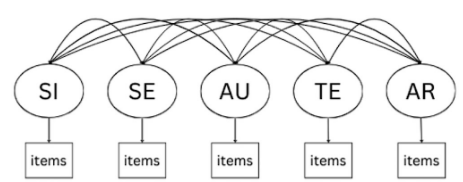
Psychological ownership—the feeling that a target is “theirs”—plays a crucial role in human-computer interactions. However, current methodological tools for exploring psychological ownership in HCI are limited, offering minimal opportunities for cross-study comparisons or generalizable measurements. This paper introduces the Scale of Psychological Ownership of Technology (SPOT), a standardized instrument for measuring psychological ownership in HCI contexts. Through semi-structured interviews (n = 25), we validate five dimensions: self-identity, self-efficacy, autonomy, territoriality, and a combined dimension of accountability and responsibility. Based on this structure, we develop SPOT through item generation, refinement, and validation processes. The final 18-item instrument exhibits strong psychometric properties across exploratory and confirmatory factor analyses (n = 410), with high reliability and good model fit indices for both tangible and intangible technological artifacts. SPOT provides researchers with a robust tool for measuring psychological ownership across diverse technology contexts.
Psychological Ownership in HCI: Dimensions and Development of an Instrument
Mengqiu Cheng, Yuxin Xu, Anastasia Kuzminykh
International Journal of Human–Computer Interaction 2026 Spotlight
Psychological ownership—the feeling that a target is “theirs”—plays a crucial role in human-computer interactions. However, current methodological tools for exploring psychological ownership in HCI are limited, offering minimal opportunities for cross-study comparisons or generalizable measurements. This paper introduces the Scale of Psychological Ownership of Technology (SPOT), a standardized instrument for measuring psychological ownership in HCI contexts. Through semi-structured interviews (n = 25), we validate five dimensions: self-identity, self-efficacy, autonomy, territoriality, and a combined dimension of accountability and responsibility. Based on this structure, we develop SPOT through item generation, refinement, and validation processes. The final 18-item instrument exhibits strong psychometric properties across exploratory and confirmatory factor analyses (n = 410), with high reliability and good model fit indices for both tangible and intangible technological artifacts. SPOT provides researchers with a robust tool for measuring psychological ownership across diverse technology contexts.
Tutor-Learner Physiological Synchrony & Rapport in Cross-Reality Interactions
Michelle Lui, Mengqiu Cheng, Jiaying Yu, Martha Mullally
Annual meeting of the American Educational Research Association (AERA) 2025
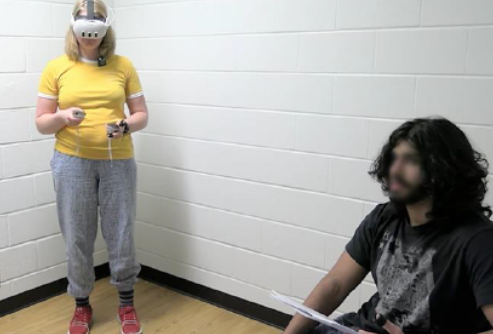
Recent research on cross-reality collaboration highlights the challenges in communication and coordination for learners in VR due to the occlusion of facial expressions and body language. In cross-reality settings, one learner uses a head-mounted display while their partner accesses the environment on a traditional display, hindering joint visual awareness. Building on prior work linking rapport to collaborative learning outcomes, this study examines the relationships between physiological synchrony, perceived experiences, and learning outcomes in cross-reality VR tutoring sessions. Using multimodal data, including physiological measurement, self-report measures, and systematic rating of video sessions, findings indicate that learning outcomes depend on both experiential factors (rapport and presence) and physiological synchrony measures, with different synchrony patterns predicting specific collaboration quality dimensions across the sessions.
Tutor-Learner Physiological Synchrony & Rapport in Cross-Reality Interactions
Michelle Lui, Mengqiu Cheng, Jiaying Yu, Martha Mullally
Annual meeting of the American Educational Research Association (AERA) 2025
Recent research on cross-reality collaboration highlights the challenges in communication and coordination for learners in VR due to the occlusion of facial expressions and body language. In cross-reality settings, one learner uses a head-mounted display while their partner accesses the environment on a traditional display, hindering joint visual awareness. Building on prior work linking rapport to collaborative learning outcomes, this study examines the relationships between physiological synchrony, perceived experiences, and learning outcomes in cross-reality VR tutoring sessions. Using multimodal data, including physiological measurement, self-report measures, and systematic rating of video sessions, findings indicate that learning outcomes depend on both experiential factors (rapport and presence) and physiological synchrony measures, with different synchrony patterns predicting specific collaboration quality dimensions across the sessions.
What Makes It Mine? Exploring Psychological Ownership over Human-AI Co-Creations
Yuxin Xu, Mengqiu Cheng, Anastasia Kuzminykh
Proceedings of the 50th Graphics Interface Conference 2024 Spotlight
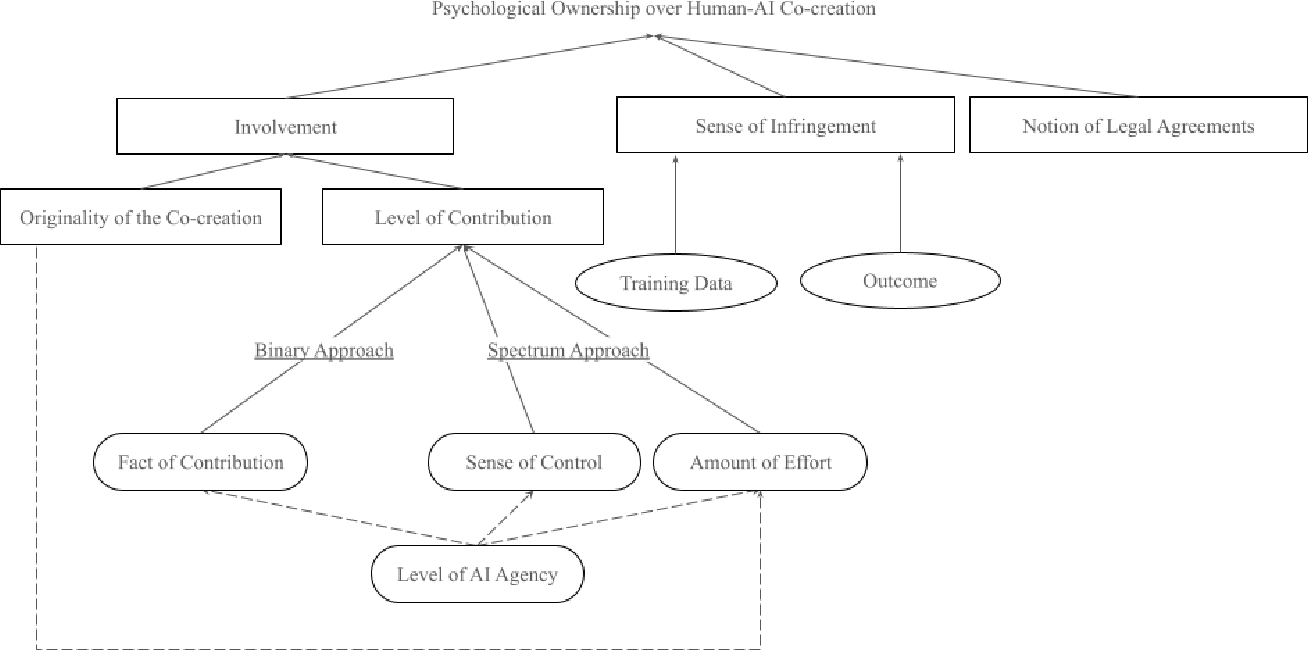
As generative AI (GenAI) rapidly evolves, human-AI collaboration emerges as a prevalent new working style. However, within this collaborative pipeline, multiple stakeholders are involved besides the user and the system itself, raising controversy around ownership over co-creations. In this paper, we explored everyday users’ sense of ownership toward human-AI co-creation, aiming to provide insights for practitioners on future GenAI design to enhance user experience. We identify three primary factors associated with people’s perception of psychological ownership towards human-AI co-creation and systematically analyze individuals’ approaches to assessing these factors. The findings serve to inform strategies for facilitating an appropriate sense of ownership for productive and safe usage of GenAI tools.
What Makes It Mine? Exploring Psychological Ownership over Human-AI Co-Creations
Yuxin Xu, Mengqiu Cheng, Anastasia Kuzminykh
Proceedings of the 50th Graphics Interface Conference 2024 Spotlight
As generative AI (GenAI) rapidly evolves, human-AI collaboration emerges as a prevalent new working style. However, within this collaborative pipeline, multiple stakeholders are involved besides the user and the system itself, raising controversy around ownership over co-creations. In this paper, we explored everyday users’ sense of ownership toward human-AI co-creation, aiming to provide insights for practitioners on future GenAI design to enhance user experience. We identify three primary factors associated with people’s perception of psychological ownership towards human-AI co-creation and systematically analyze individuals’ approaches to assessing these factors. The findings serve to inform strategies for facilitating an appropriate sense of ownership for productive and safe usage of GenAI tools.